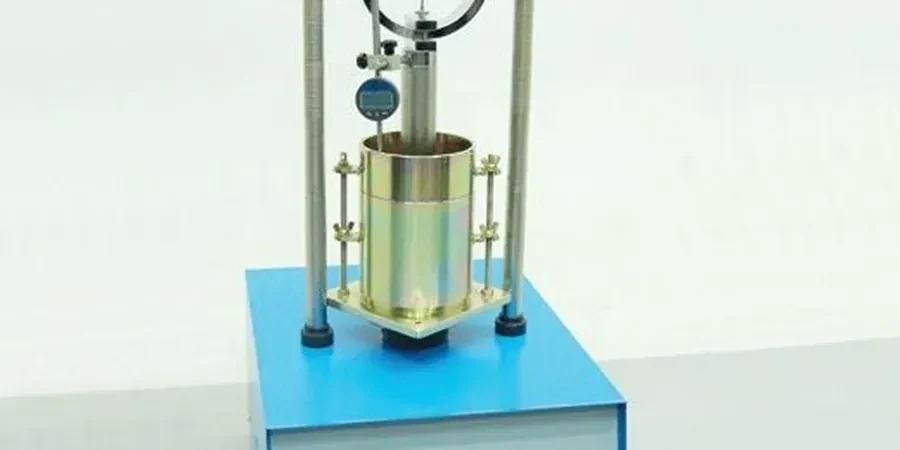
The most common mistake we see on Southend-on-Sea projects is assuming a design CBR value from a desk study. The estuarine deposits along the Thames corridor are notoriously variable — a borehole log from a site 200 metres away can be completely misleading. We have pulled samples from Shoeburyness that tested at 2% CBR while material from a site near Priory Park hit 8% at the same depth. That difference collapses a pavement design if you guess wrong. A proper laboratory CBR test eliminates that risk. Our lab runs soaked CBR to BS 1377-4:1990, which matters here because the water table in Southend-on-Sea sits high — often within a metre of finished ground level — and unsoaked values simply do not represent field conditions. We complement the subgrade assessment with grain size analysis to confirm fines content, and when the material is borderline cohesive, we run Atterberg limits to flag volumetric sensitivity before the pavement engineer commits to a formation treatment.
A soaked CBR value of 2% versus 5% can mean the difference between a 400 mm capping layer and full subgrade replacement — getting this wrong costs more than the test ever will.
Process overview
Southend-on-Sea has a population of roughly 183,000 and sits on predominantly cohesive soils that require careful handling for pavement earthworks. Our laboratory CBR testing programme addresses three practical concerns: first, sample preparation must replicate field density and moisture content accurately — we use static compaction to BS 1377-4 rather than dynamic, because dynamic compaction can artificially break down clay particles and inflate the result. Second, the four-day soak period is non-negotiable; we have seen CBR values stabilise after day three but drop again on day four in highly plastic London Clay from the Thorpe Bay area. Third, the surcharge weight applied during soaking matters — we match the calculated overburden pressure at the formation level, not a generic 4.5 kg ring, because a 600 mm capping layer exerts a different confining stress than a 150 mm sub-base. Each test generates a force-penetration curve with correction for surface irregularities, and we report the CBR at 2.5 mm and 5.0 mm penetration, flagging any anomalous results where the 2.5 mm value exceeds the 5.0 mm value — a sign of sample disturbance worth investigating before the pavement design is locked in.
Local context
Southend-on-Sea sits on a geological boundary: London Clay outcrops across the north and west of the borough, while the southern strip toward the seafront and the airport is underlain by brickearth and head deposits over Thames gravel. The risk profile changes completely between these two domains. London Clay loses significant strength when wetted — soaked CBR values can be less than half the as-sampled figure. The brickearth, by contrast, is silt-dominant and prone to collapse settlement if not identified early. Our laboratory programme replicates worst-case saturation because, in a coastal town with 550 mm of annual rainfall and a shallow aquifer, the subgrade will be wet for much of its service life. A single unsoaked CBR result gives a false sense of security; we run paired soaked and unsoaked specimens as standard, and the difference between them often drives the decision on whether to stabilise, replace, or thicken the capping layer.
Quick answers
How much does a laboratory CBR test cost in Southend-on-Sea?
A single-point soaked CBR test to BS 1377-4 typically costs between £100 and £170, depending on whether you need the full swell measurement, paired unsoaked comparison, and the number of compaction points required. A subgrade characterisation package combining CBR with particle size distribution and Atterberg limits runs higher but saves the cost of mobilising a second sampling round.
Why do I need a soaked CBR value rather than unsoaked?
Southend-on-Sea has a high water table and significant annual rainfall, so the subgrade will be wet for extended periods. An unsoaked CBR test can overestimate strength by 50% or more in London Clay. Soaked testing to BS 1377-4 replicates worst-case field conditions, which is what the DMRB pavement design method requires as the design input.
Can you test samples taken from trial pits or only from boreholes?
We can test disturbed bulk samples from both sources. The key requirement is sample mass — we need at least 25 kg of material for a single CBR compaction point, or 50 kg if you also want classification testing on the same material. Samples should be sealed in heavy-duty polythene bags immediately after extraction to preserve natural moisture content.
What CBR value should I expect for London Clay in the Southend area?
There is no single number — that is precisely why testing is essential. Soaked CBR values for London Clay in the Southend-on-Sea area typically range from 1% to 5%, but we have recorded values above 8% in stiffer zones near the Rayleigh boundary. Brickearth and head deposits further south can show higher values but are more susceptible to moisture-induced collapse. Site-specific sampling and testing is the only reliable approach.