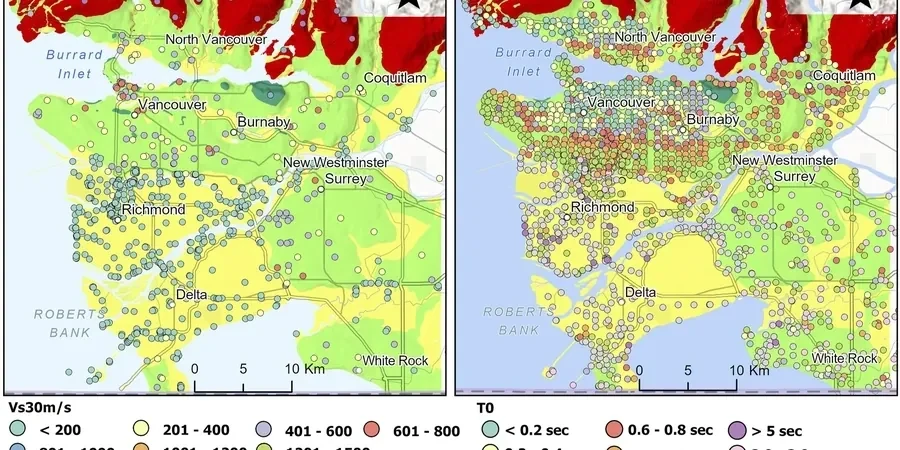
In Southend-on-Sea, the geology shifts fast—within half a mile you can go from London Clay to the Thames Estuary alluvium and then into the Bagshot Sands that cap the higher ground around Leigh. That matters for seismic response, because soft estuarine clays amplify ground motion in ways that stiff clays simply don’t. We’ve seen sites where a routine desk study flagged ‘low seismicity’, but the site-specific MASW survey showed a fundamental period that lined up uncomfortably well with the resonant frequency of a proposed four-storey steel frame. Seismic microzonation in Southend-on-Sea isn’t just about ticking the Eurocode 8 box; it’s about mapping how the ground will actually behave—layer by layer—across the postcode. The study combines borehole shear-wave velocity profiles, ambient vibration measurements, and CPT data to produce spectral acceleration maps that civil and structural engineers can use directly in design. When the bedrock is 30 or 40 metres down and the cover is interbedded clay, silt, and peat, the amplification factor isn’t something you guess from a generic table.
A site class change from D to E can double the design spectral acceleration—and in Southend-on-Sea’s estuarine margins, that change often happens within a single building footprint.
Local context
The kit we deploy for seismic microzonation in Southend-on-Sea starts with a triaxial geophone array lowered into a cased borehole—typically a 100 mm diameter hole drilled through the alluvium and seated a metre into the London Clay or Thanet Sand formation. The source is a triggered sledgehammer on a steel plate at surface, with signal stacking to pull the shear-wave arrival out of the background noise from the A13 or the railway line. In the estuary margins, the biggest risk isn’t the earthquake itself—it’s the combination of moderate ground shaking with high groundwater and loose silty sand lenses that can trigger flow liquefaction, a phenomenon documented globally in reclaimed coastal fills. Our liquefaction assessment runs Seed-Idriss simplified procedure on every SPT and CPT blow count, factoring in the fines content from lab testing, and maps the factor of safety against liquefaction across the site. We’ve found lenses at four to seven metres depth near the seafront where the FoS drops below 1.1 under the 475-year event, and that changes the foundation strategy from shallow pads to piled solutions almost overnight.
Quick answers
Is seismic microzonation mandatory for a low-rise residential scheme in Southend-on-Sea?
Not always mandatory, but strongly recommended when the site investigation identifies soft alluvial soils or when the structure falls under Consequence Class CC2 or CC3 as defined in BS EN 1990. If the desk study shows the site is underlain by more than five metres of estuarine clay or silt, the Building Control officer or SER certifier will often request a ground-type classification beyond the default assumption. A seismic microzonation study provides that evidence and can sometimes demonstrate that a more favourable site class applies, avoiding unnecessary foundation overdesign.
What does a seismic microzonation study cost for a typical Southend-on-Sea site?
For a site in Southend-on-Sea, a seismic microzonation study typically ranges from £2,930 for a single-borehole Vs profile with basic ground classification up to £14,980 for a multi-hectare development involving several boreholes, surface geophysics, liquefaction analysis, and one-dimensional site response modelling. The final figure depends on the number of measurement points, the depth to engineering rock, and the level of reporting required by the certifier.
How long does a seismic microzonation survey take from start to final report?
Fieldwork—comprising borehole drilling, geophone logging, and surface MASW lines—usually takes three to five working days on site. Laboratory testing of samples for fines content and plasticity adds another week. The interpretation, site response modelling, and reporting phase typically runs two to three weeks. A realistic timeline from mobilisation to final report is four to five weeks, assuming weather and access allow uninterrupted drilling.