← Home · Seismic

Soil Liquefaction Assessment in Southend-on-Sea: BS EN 1997 Analysis

Together, we solve the challenges of tomorrow.

SEE MORE →

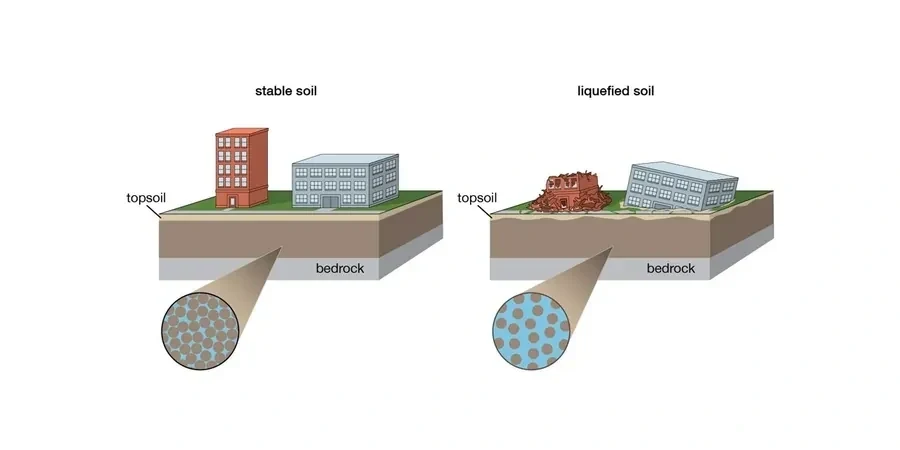
The Thames Estuary alluvium beneath Southend-on-Sea conceals a well-known geotechnical hazard: loose, saturated fine sands interbedded with soft silts. Across the borough, from the cliff slopes of Westcliff to the reclaimed ground near Shoeburyness, the water table often sits within two metres of the surface. These conditions demand a rigorous soil liquefaction analysis whenever a structure is classed as Importance Class 2 or higher under Eurocode 7. Our approach couples in-situ penetration data—typically SPTs advanced through the Holocene sequence—with laboratory cyclic triaxial testing. For sites on the London Clay outcrops that dip south under the estuary, the risk shifts, but the river terrace gravels and overlying made ground still warrant a site-specific assessment. A seismic microzonation study often complements the borehole campaign where the development footprint exceeds 0.25 hectares.

In Southend’s Holocene alluvium, a thin 200 mm silt seam can control the entire liquefaction response of a foundation—missing it changes the site class.

Process overview

Comparing Leigh-on-Sea with central Southend highlights the variability we encounter. Leigh sits partly on the London Clay Formation, where liquefaction susceptibility is low except in pockets of alluvium along the creeks. Central Southend, however, is built extensively on the Taplow-Mucking terrace deposits—medium-dense sands with discontinuous silt lenses that can trigger flow failure under long-duration shaking. Our factor-of-safety calculations follow the NCEER/Youd 2001 framework, corrected for fines content via BS 1377-2:1990 grain-size tests. For critical infrastructure near the pier, we often recommend a CPT sounding to capture a continuous soil-behaviour-type profile, because SPT intervals can miss thin liquefiable laminae.
The assessment always finishes with a post-liquefaction settlement estimate, which in Southend’s silty sands can exceed 40 mm—enough to rupture shallow utilities and differential settlement-sensitive facades.
Soil Liquefaction Assessment in Southend-on-Sea: BS EN 1997 Analysis
Technical reference image — Southend-on-Sea

Local context

Southend-on-Sea’s population sits at roughly 183,000, with major regeneration planned around the Victoria Avenue corridor. A moderate earthquake—magnitude 4.5 at 15 km depth, originating in the Dover Strait—would produce enough ground motion to trigger liquefaction in the loose estuarine sands beneath the town centre. The Environment Agency’s groundwater records show the aquifer here responds rapidly to tidal cycles, meaning the saturated state needed for excess pore pressure buildup is effectively permanent. Undetected liquefiable layers can cause lateral spreading toward the estuary foreshore, where gradients are less than 0.5%. The cost of remediation post-construction dwarfs the investment in a pre-design analysis. We have observed this in projects where stone columns had to be retrofitted after settlement cracks appeared in a completed slab.

Need a geotechnical assessment?

Reply within 24h.

Email: contact@geotechnical-engineering1.com

Technical parameters


ParameterTypical value
Design ground motion0.10–0.15g PGA (475-year return, UK hazard)
Depth to groundwater (typical)0.8–2.5 m below ground level
Critical layer depth range2–12 m (Taplow-Mucking sands)
Fines content threshold<15% (high susceptibility per Seed-Idriss)
SPT N₁₆₀ range of concernN₁₆₀ ≤ 12 blows/300 mm
Laboratory methodCyclic triaxial (BS EN ISO 17892-4)
Reporting standardEurocode 8 Part 1 & 5 (BS EN 1998)

Additional services

01

Simplified Liquefaction Triggering Analysis

SPT- or CPT-based evaluation of factor of safety against liquefaction at each test depth, using the Boulanger & Idriss (2014) update to the NCEER method. We correct for overburden stress, fines content, and earthquake magnitude specific to the UK seismic hazard model.

02

Post-Liquefaction Settlement & Lateral Spread Assessment

Volumetric strain and shear-induced deformation estimates following the procedures of Ishihara & Yoshimine (1992) and Zhang et al. (2002). Outputs feed directly into foundation performance checks under Serviceability Limit State.

Reference standards

BS EN 1998-1:2004+A1:2013 (Eurocode 8 Part 1), BS EN 1998-5:2004 (Eurocode 8 Part 5), BS 5930:2015+A1:2020 (Code of practice for ground investigations), BS 1377-2:1990 (Classification tests), BS EN ISO 17892-4:2016 (Triaxial)

Common questions

What depth of investigation is needed for a liquefaction study in Southend?

We target a minimum depth of 15 m below ground level. The liquefiable Taplow-Mucking sands typically occur between 2 and 12 m depth, but the investigation must also penetrate the underlying London Clay to confirm the base of the susceptible sequence. Borehole depth is adjusted if deep made ground is present near the seafront.

How much does a soil liquefaction analysis cost in Southend-on-Sea?

A full package—covering two to three boreholes with SPTs, laboratory classification and cyclic triaxial testing, plus the analytical report—ranges from £1,800 to £3,220. The final figure depends on site access constraints and the number of test specimens required for the design earthquake scenario.

Which areas of Southend are most at risk of liquefaction?

The highest risk zones are the low-lying reclaimed and estuarine alluvium areas—central Southend, parts of Southchurch, and the coastal strip near Shoeburyness. Leigh-on-Sea and Westcliff’s higher ground, underlain by London Clay, show significantly lower susceptibility, though local creek-side alluvium can still be problematic.

Does Eurocode 8 require a liquefaction assessment for Southend?

Yes, for structures in Importance Class 2 or above where the ground investigation identifies saturated, loose to medium-dense sands and silts. The UK National Annex to BS EN 1998-1 sets a reference peak ground acceleration of approximately 0.10–0.15g for a 475-year return period, which is sufficient to trigger analysis under the code’s screening criteria.
Location and service area

We serve projects across Southend-on-Sea and its metropolitan area.

View larger map