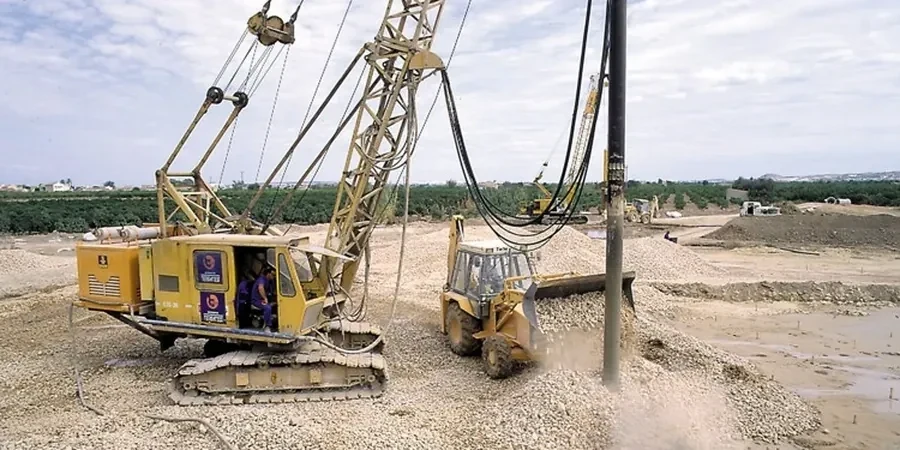
Southend-on-Sea’s expansion from a modest fishing village into a bustling seaside resort placed enormous pressure on its underlying geology. Much of the town sits atop the London Clay Formation, but the coastal strip and the area around the airport are draped in soft alluvial deposits and estuarine silts from the Thames and Roach catchments. These compressible soils, often interbedded with peat lenses, challenge conventional shallow foundations. A test pit investigation across a site near the Kursaal revealed interlayered soft clays extending to depths where traditional pad footings become uneconomical. Stone column design offers a proven Improvement alternative, installing compacted granular columns that densify the surrounding soil, create a stiffer composite mass, and carry out rapid drainage paths. In Southend-on-Sea, where the water table sits barely a metre below ground level across many postcodes, this dual function—reinforcement plus drainage—proves decisive for time-sensitive commercial and residential developments.
In saturated Southend-on-Sea silts, a well-designed stone column layout can cut consolidation time by over 70% compared to untreated ground, turning marginal land into buildable plots.
Quick answers
What ground conditions in Southend-on-Sea make stone columns the right choice?
Stone columns suit the soft alluvial clays and silty deposits prevalent along Southend’s coastal strip and the lower reaches of the River Roach. When undrained shear strength exceeds roughly 15 kPa and the compressible layer is between 4 and 18 metres thick, stone columns offer a cost-effective alternative to piling for lightly to moderately loaded structures. They are less suitable in very organic peat where lateral confinement is insufficient to mobilise column stiffness, though we can assess borderline cases with a targeted ground investigation.
How much does a stone column design package cost for a Southend-on-Sea site?
A full stone column design package — covering feasibility, detailed design, and installation monitoring — typically ranges from £1,310 to £3,730, depending on site area, column depth, and the complexity of the ground model. Simple single-block sites fall at the lower end, while phased developments with variable stratigraphy and multiple column grids sit at the upper end of that range.
How long does stone column design take from instruction to issue?
For a typical Southend-on-Sea residential or light commercial plot, preliminary design can be turned around in five to seven working days once the ground investigation data is available. Detailed design with finite element verification and full specification generally requires two to three weeks. We can accelerate programmes for urgent projects where site possession dates are fixed.
Does stone column installation cause vibration that could affect neighbouring properties in Southend?
The wet top-feed method using a vibroflot does generate ground-borne vibration, and on tight Southend sites with adjacent Victorian or Edwardian terraces, a vibration assessment is prudent. We specify maximum peak particle velocity limits in the method statement and can recommend alternative displacement techniques or reduced-energy installation near sensitive structures. Monitoring with geophones during the first few columns confirms compliance before full production proceeds.