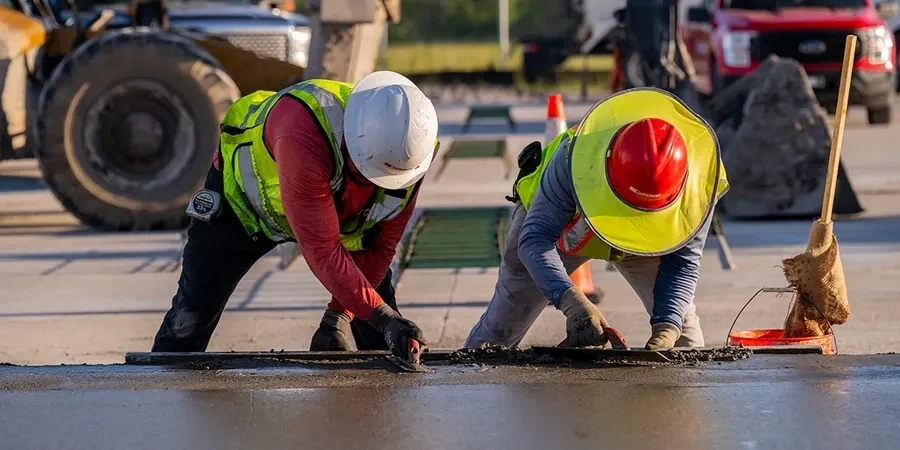
Drive from the solid gravel terraces of Leigh-on-Sea down toward the reclaimed frontages of Shoeburyness and you will cross three distinct soil regimes in under twenty minutes. That variability is exactly why rigid pavement design in Southend-on-Sea cannot rely on desktop assumptions alone. The town sits on a patchwork of London Clay, Brickearth head deposits, and marine alluvium, with groundwater often sitting barely a metre below finished grade. A concrete pavement that performs for thirty years on the gravels of Chalkwell can crack within five seasons if the same section is placed on the soft silts of the eastern wards. We ground-truth every project with targeted test pits and in-situ density work before a single pavement layer is specified, so the slab thickness, joint spacing, and subbase reinforcement match the actual subgrade, not a textbook generalisation.
A rigid pavement in Southend-on-Sea lives or dies by the subgrade modulus, not the concrete strength.
Reference standards
BS 5930:2015+A1:2020 – Code of practice for ground investigations, UK National Annex to Eurocode 7 (BS EN 1997-1:2004+A1:2013), DMRB CD 226 – Design for new pavement construction, BS 8500-1:2015+A2:2019 – Concrete, complementary British Standard to BS EN 206, Specification for Highway Works (SHW) Series 1000
Quick answers
What is the typical cost of rigid pavement design for a Southend-on-Sea commercial development?
For a standalone pavement design package tied to a site investigation in Southend-on-Sea, budgets generally fall between £1,680 and £4,550 depending on the footprint area, traffic loading class, and number of subgrade zones that need characterisation. A small access road on uniform gravel will sit at the lower end; a heavily loaded distribution-centre yard crossing London Clay and alluvium transitions will require more sampling and analysis, moving toward the upper range.
Why choose rigid pavement over flexible pavement in Southend-on-Sea?
Rigid pavements distribute wheel loads over a wider area through slab action, which is particularly useful on the lower-strength subgrades found in the eastern wards of Southend-on-Sea. They also resist fuel and oil spillage better and require less frequent resurfacing, which reduces disruption on busy commercial sites. The trade-off is higher initial cost and a need for precise joint detailing to accommodate the thermal and moisture movement typical of the estuary climate.
How deep do you investigate the ground for a rigid pavement design?
We typically investigate to a depth of at least 2.0 m below proposed formation level, and deeper if the desk study indicates soft alluvium or made ground extending further down. In Southend-on-Sea, where reclaimed land and Brickearth over London Clay are common, we often use a combination of machine-dug trial pits and dynamic cone penetration testing to capture the transition between the weathered and unweathered clay profile.
What is the design life of a rigid pavement in a coastal environment like Southend?
A properly designed and constructed rigid pavement in Southend-on-Sea can achieve a structural design life of 40 years, provided the concrete mix addresses the local sulphate and chloride exposure and the joint sealants are maintained on a scheduled cycle. The main life-limiting factor here is not traffic loading but moisture-driven degradation, which is why our designs place as much emphasis on drainage and concrete durability as on slab thickness.