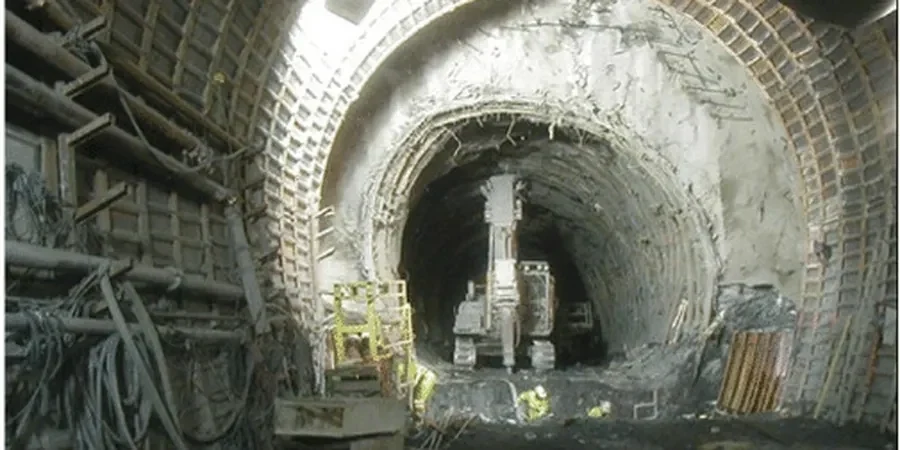
A drainage tunnel project near the Thames Estuary hit a 4-metre band of soft alluvial clay at just 7 metres depth. The groundwater table sat less than 2 metres below street level. The contractor had assumed stiff London Clay throughout the drive—within hours, the face began to squeeze and the crown settlement exceeded 30 millimetres. That job stopped for six weeks while we re-characterised the entire alignment. In Southend-on-Sea, the stratigraphy shifts rapidly between the London Clay Formation and overlying soft alluvial and terrace gravel deposits. A CPT test pushed continuously through these transitions gives us a near-continuous strength profile without sample disturbance, and when we need index properties for classification we run Atterberg limits on undisturbed samples taken from adjacent boreholes. The Estuary's tidal influence means pore pressures fluctuate daily, so steady-state modelling assumptions do not hold. We design the investigation around that reality.
In Southend's estuarine ground, the difference between a successful tunnel drive and a face collapse often comes down to 50 centimetres of unanticipated sand lens.
Process overview
BS EN 1997-2:2007 (Eurocode 7 Part 2) requires ground investigation to extend at least 1.5 times the tunnel diameter below invert level for soft ground conditions—and in Southend-on-Sea that depth frequently intersects the Lambeth Group sands, which can carry artesian pressure near the foreshore. Our field programme combines rotary-cored boreholes with piezometer installations screened at multiple horizons. We log to BS 5930:2015+A1:2020, capturing discontinuity spacing, weathering grade, and consistency index in real time. Laboratory testing runs in parallel: consolidated-undrained triaxial with pore pressure measurement delivers the effective stress parameters needed for undrained stability analysis, while oedometer tests on the alluvial clays give us the constrained modulus for settlement prediction. We do not rely on a single investigation method. Where access permits, we push seismic cone penetration tests to measure shear wave velocity directly—this feeds into the ground model for both static and seismic deformation assessment. The output is a ground model that distinguishes between the weathered clay crust, the intact London Clay, the water-bearing gravel lenses, and the underlying dense sands.
Local context
Southend-on-Sea sits on the northern flank of the London Basin syncline, with the London Clay outcropping along the cliffs west of the Pier and dipping gently south-east beneath Holocene alluvium. The alluvial sequence—soft silty clays, peat lenses, and saturated gravels—extends from the foreshore inland for roughly 1.5 kilometres. Tunnel face instability in these materials develops fast. Low undrained shear strength, combined with tidal pore pressure cycling, reduces the stand-up time to hours rather than days. If the tunnel alignment crosses the contact between the alluvium and the London Clay, differential settlement can crack segmental linings before the annulus grout has set. Another hazard is the sand channels within the Claygate Member: they carry water under confined conditions, and a probe hole that penetrates one without a blowout preventer can flood the heading in minutes. We map these risks explicitly in the Ground Investigation Report, assigning a hazard index to each reach of the alignment so the contractor can plan face support, dewatering, and contingency measures with full knowledge of the ground ahead.
Quick answers
What ground investigation is required before tunnelling in Southend-on-Sea?
At minimum, a phased investigation to BS 5930 and BS EN 1997-2. Phase 1 typically includes rotary-cored boreholes at 50- to 100-metre spacing along the alignment, with SPTs in granular layers and undisturbed sampling in clays. Phase 2 fills gaps with CPT soundings and installs piezometers to monitor tidal influence on groundwater. The investigation must extend at least 1.5 times the tunnel diameter below invert and laterally to capture any geological boundaries that could affect face stability.
How much does a soft ground tunnel geotechnical analysis cost in Southend-on-Sea?
A full tunnel alignment investigation with laboratory testing and interpretative reporting typically ranges from £3,500 to £14,730, depending on the length of the alignment, the number of boreholes, and the complexity of the laboratory programme. Short drives under 200 metres with straightforward geology fall at the lower end; longer alignments crossing multiple geological units with extensive triaxial testing sit at the upper end.
How do you deal with the high groundwater in the Thames Estuary area?
We install standpipe and vibrating-wire piezometers at multiple depths to capture the vertical head distribution. Monitoring over at least one full spring-neap tidal cycle lets us quantify the tidal efficiency and lag time. These data feed directly into seepage analyses and dewatering design. Where artesian conditions are suspected in the Lambeth Group sands, we specify drilling with a casing advance system and a blowout preventer to safely control any confined water encountered.
What laboratory tests are essential for tunnel design in soft clay?
Consolidated-undrained triaxial tests with pore pressure measurement are the cornerstone—they give effective stress parameters (c' and φ') and undrained strength (su) for stability analysis. Oedometer tests on the alluvial clays carry out the stiffness values for settlement prediction. Index testing (Atterberg limits, particle size distribution) supports material classification and helps correlate strength with simpler index properties across the site. For time-dependent settlement, we may also run incremental loading oedometer tests to measure the coefficient of consolidation.