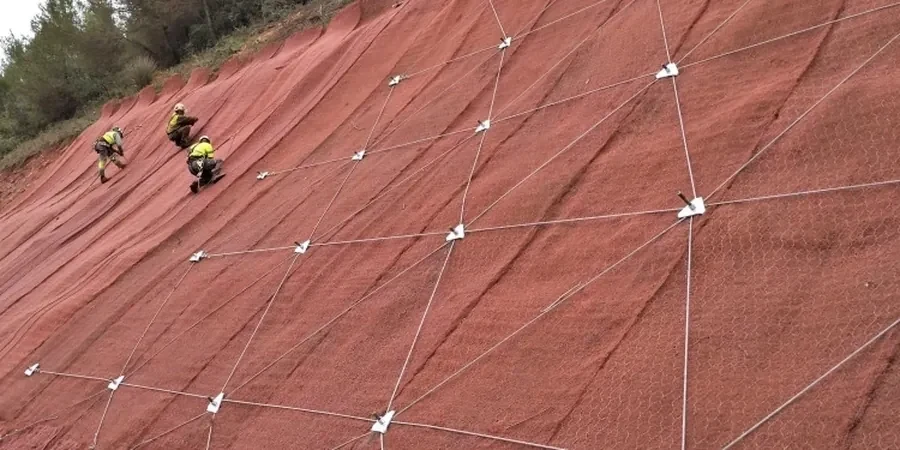
A retaining structure in Westcliff failed during a wet winter, and the contractor couldn't understand why. The slope looked fine in August. That's the thing about Southend-on-Sea slopes: the London Clay base and overlying sand layers create a perched water table that builds up slowly, then triggers failure when pore pressures peak. We were called in to do a proper slope stability analysis, and the back-analysis showed the factor of safety dropped below 1.0 once groundwater rose into the sand. In our expertise across the town, from Leigh-on-Sea to Thorpe Bay, the interaction between the Claygate Beds and the underlying stiff London Clay dictates the failure mechanism. A desk study alone won't catch it. You need borehole data, piezometer readings and a limit equilibrium model calibrated to the real stratigraphy. Complementing the investigation with test pits helps verify the near-surface geology, while a triaxial test provides the effective stress parameters that govern drained behaviour in the clay.
A factor of safety of 1.0 in summer can become 0.85 by February if groundwater isn't accounted for in the London Clay slopes of Southend-on-Sea.
Local context
The most common mistake we see in Southend-on-Sea is treating the slope as a homogeneous clay mass. When the Claygate sand lenses are ignored, the analysis misses the perched water problem entirely. The result is a design that works on paper but fails in the field, usually after prolonged rainfall. Another expensive error is using total stress parameters from a quick undrained triaxial and applying them to a long-term drained scenario. London Clay softens with time; the operational strength is closer to the fully softened value, especially in weathered zones near the surface. We've reviewed slope stability reports where the critical slip surface was constrained to a search radius that excluded the toe, simply because the software default was too narrow. In Southend-on-Sea, with the estuary cutting into the cliff at Chalkwell and Westcliff, toe failure is precisely what you need to check. Ignoring marine erosion means the model geometry doesn't represent reality. The cost of getting this wrong isn't just the remediation; it's the Section 38 notices, the party wall disputes and the insurance claim that follows.
Quick answers
What is the typical cost of a slope stability analysis for a residential site in Southend-on-Sea?
For a single residential plot with an existing slope, a full slope stability analysis including a ground investigation, laboratory testing and limit equilibrium modelling typically ranges from £980 to £3,060 depending on slope height, access constraints and the number of boreholes required.
Which parts of Southend-on-Sea are most affected by slope instability?
The cliff line running from Leigh-on-Sea through Chalkwell and Westcliff is the most active area, where London Clay and Claygate Beds are exposed to marine erosion at the toe. Inland slopes along the Prittle Brook valley also show historical shallow landslide activity.
Do I need a slope stability analysis for a single-storey extension near a slope?
If the extension is within the zone of influence of the slope, usually defined as a 1:3 line from the toe or a distance equal to the slope height from the crest, then yes. Building Control in Southend-on-Sea will often request a slope stability assessment under Approved Document A when the slope exceeds 1:6 gradient.
How long does a slope stability assessment take from start to finish?
A typical programme runs four to six weeks: one week for ground investigation and piezometer installation, two weeks for laboratory testing, and one to two weeks for modelling and reporting. Seasonal groundwater monitoring may extend the programme if baseline winter readings are required.
What's the difference between total stress and effective stress analysis for London Clay slopes?
Total stress analysis uses undrained shear strength (cu) and is appropriate for short-term conditions during construction. Effective stress analysis uses c' and φ' with pore water pressures and governs long-term stability. In Southend-on-Sea, where clay softening occurs over decades, effective stress parameters control the permanent design case.