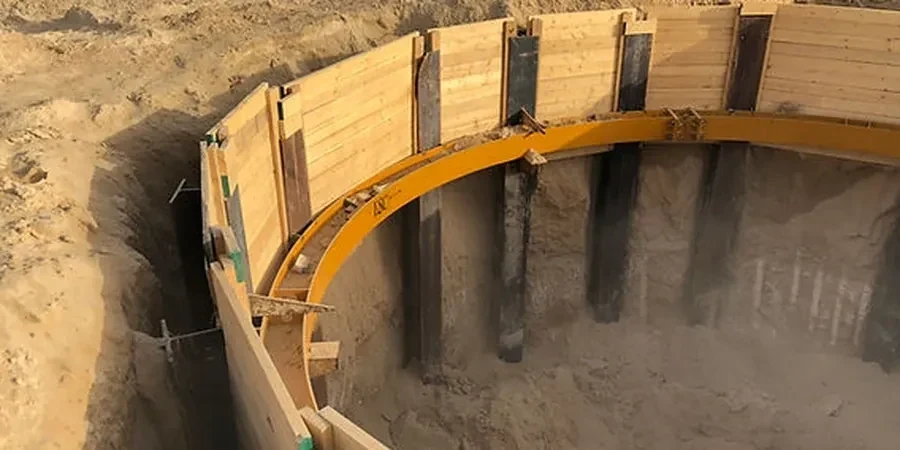
The ground beneath Southend-on-Sea tells two very different stories. Along the seafront and the central pier area, the underlying London Clay Formation lies relatively close to the surface, offering a stiff, overconsolidated material that can carry out excellent end-bearing capacity for deep foundations. Move north toward the residential spreads of Leigh-on-Sea or the commercial zones near Priory Park, and the profile shifts: thick sequences of alluvial gravels and soft estuarine silts dominate, often with groundwater within the first two metres. Designing a pile foundation here means reading these transitions carefully. A solution that works on the firm clay of the cliffs may be entirely inadequate for the compressible soils of the Thames estuary margins. Our pile foundation design service addresses this variability head-on, producing foundation schemes that are precisely tuned to the local stratigraphy revealed by site investigation. Before committing to a pile type, the characterisation of the superficial deposits is critical, and we often integrate test pits to verify the shallow sequence and confirm the depth to competent strata.
Pile design in Southend-on-Sea is a negotiation with two materials: the stiff London Clay and the unpredictable alluvium of the Thames corridor.
Local context
The superficial geology along the Southend-on-Sea coastline includes pockets of soft, normally consolidated silty clay and loose sand lenses that are susceptible to liquefaction under cyclic loading. The British Geological Survey maps the area as underlain by the London Clay Formation, but the thickness of the overlying alluvium can exceed eight metres in the estuarine zones. A pile foundation that does not penetrate these weak surficial layers risks excessive settlement and loss of bearing. Negative skin friction is a further hazard if fill or compressible soils consolidate around the pile shaft after construction. Groundwater is typically encountered at shallow depth, complicating boring operations and requiring careful consideration of shaft integrity during concreting. Our designs incorporate a minimum socket length into the competent clay, verified against the site-specific ground model, and we specify full-length reinforcement cages where lateral loads from wind or vessel impact govern the structural demand.
Quick answers
What is the typical cost range for pile foundation design in Southend-on-Sea?
The design fee for a pile foundation in Southend-on-Sea generally falls between £1,320 and £4,750, depending on the complexity of the ground conditions, the number of piles, and the structural loading. A straightforward scheme for a residential extension on London Clay will be at the lower end, while a commercial development in the alluvial zone requiring load testing and detailed settlement analysis will command a higher fee. We carry out a fixed-price proposal after reviewing the available ground investigation data.
Which pile type is most suitable for the London Clay in Southend-on-Sea?
Continuous flight auger (CFA) piles and bored cast-in-place piles are commonly used in the London Clay of Southend-on-Sea. They carry out good shaft friction, can be installed with minimal vibration, and are capable of penetrating the stiff clay to reach a competent bearing stratum. Driven precast piles are also effective but require assessment of noise and vibration, especially in the densely built-up areas of the town centre.
How does Eurocode 7 influence pile design decisions for my project?
Eurocode 7 requires a clear distinction between ultimate and serviceability limit states, with partial factors applied to actions, material properties, and resistances. For pile design, this means we must demonstrate that the foundation has sufficient safety against collapse and that settlements under working loads are acceptable. The UK National Annex provides the specific factors to be used, and our designs follow the Design Approach 1 combination of factors, which is standard practice in the UK.