← Home · Excavations

Geotechnical Excavation Monitoring in Southend-on-Sea

Together, we solve the challenges of tomorrow.

SEE MORE →

The site team had just opened a 6-metre cut for a new residential block near Victoria Avenue when the first signs of groundwater appeared much sooner than the desk study predicted. Southend-on-Sea sits on a complex sequence of London Clay overlaid by alluvial sands and gravels from the Thames Estuary, and the water table here rarely behaves as the textbooks suggest. We set up an array of inclinometers, piezometers, and surface settlement markers within 48 hours, tying real-time readings back to the trigger levels defined in the temporary works design. In this town, where the tidal influence reaches surprisingly far inland through the gravel lenses, monitoring is not a tick-box exercise—it is the only reliable way to catch a developing problem before it reaches the hoarding line. Many contractors in the area now pair our monitoring programme with a deep excavation assessment early in the design phase, so the instrumentation layout is coordinated with the predicted deformation profile rather than bolted on afterwards.

In Southend’s estuarine ground, the difference between a controlled dig and an emergency backfill is often a few millimetres of movement caught early.

Process overview

The core of a Southend monitoring job is usually a combination of in-place inclinometers installed in boreholes behind the retaining wall and vibrating-wire piezometers pushed into the key water-bearing horizons. On a recent job off Southchurch Road we deployed an automated total station network with prisms fixed to the shoring walers, which gave the structural engineer a continuous deflection plot without anyone needing to enter the dig. That setup works well until the sea mist rolls in and plays havoc with the optics, so we always back it up with manual tape extensometer readings at the critical sections. The data flows into a cloud dashboard where the temporary works designer can check movements against the agreed amber and red thresholds, and the site manager gets an SMS if a piezometer hits a pore pressure spike after a spring tide. Every instrument is calibrated to BS 5930 procedures before it leaves the yard, and the logging interval is tightened to 15 minutes during the first excavation stage when the soil is most reactive.
Geotechnical Excavation Monitoring in Southend-on-Sea
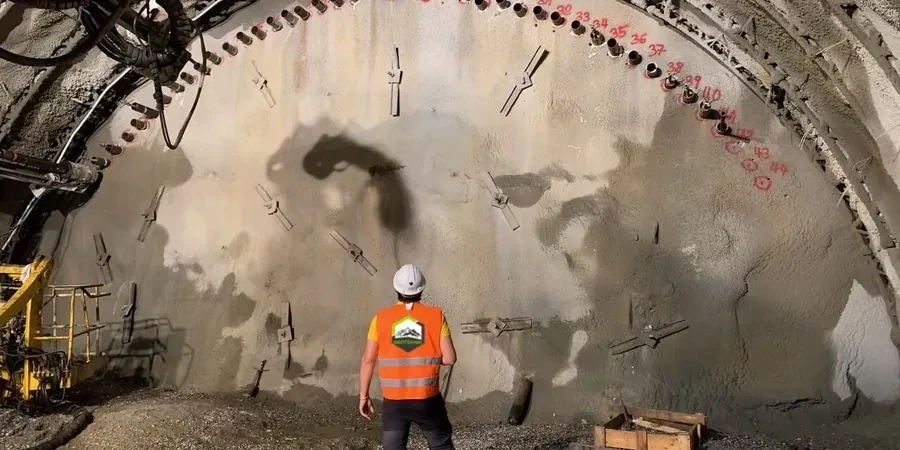
Technical reference image — Southend-on-Sea

Local context

Ground behaviour varies sharply across the borough. The cliff-top areas west of the pier sit on stiff London Clay that can stand almost vertically for days but then slumps without warning when a persistent rainfall saturates the weathered crust. Down in the central commercial district, around the High Street, the alluvial gravels drain so freely that dewatering is the main challenge—but draw the water level down too aggressively and the fine sand fraction starts to migrate, causing settlement under neighbouring footings. Our monitoring plan for each zone weights the risks differently: inclinometers dominate the cliff jobs, while multi-level piezometers and settlement arrays do the heavy lifting in the gravels. When a scheme falls within 50 metres of the Thames Estuary foreshore, we also incorporate a liquefaction assessment because the loose silty sands that occur in the Southend area can lose strength under cyclic loading from heavy piling rigs or even prolonged construction traffic vibration.

Need a geotechnical assessment?

Reply within 24h.

Email: contact@geotechnical-engineering1.com

Technical parameters


ParameterTypical value
Monitoring frequency – active excavation15–30 min (real-time)
Settlement marker accuracy±0.5 mm (digital level)
Inclinometer resolution0.01 mm/m (verticality check)
Piezometer range0–350 kPa (vibrating-wire)
Total station rangeUp to 300 m (ATR mode)
Crack gauge sensitivity0.1 mm crack opening
Data reportingDaily summary + threshold alarm

Additional services

01

Inclinometer & Deflection Monitoring

In-place and traversing inclinometer arrays installed through the retained ground to track lateral deformation with depth. Combined with automated total station measurements on the waler beams.

02

Piezometer & Groundwater Control

Vibrating-wire and standpipe piezometers placed at multiple horizons to separate perched water in the gravels from the deeper aquifer. Readings correlated with tide tables for the Thames Estuary.

03

Surface & Building Settlement Surveys

Precise levelling of settlement markers on the highway, adjacent buildings, and buried utilities. Crack gauges and tilt meters added when the zone of influence extends under sensitive structures.

04

Real-Time Alarm & Reporting System

All instruments networked into a cloud platform with configurable amber and red thresholds. Automatic notifications sent to the site team and the designer when movement or pore pressure exceeds agreed limits.

Reference standards

BS 5930:2015+A1:2020 – Code of practice for ground investigations, Eurocode 7 (BS EN 1997-1:2004) – Geotechnical design, CIRIA C760 – Guidance on embedded retaining wall design, BS EN ISO 18674 series – Geotechnical monitoring by field instrumentation

Common questions

What instrument accuracy do you guarantee for a deep dig in Southend’s London Clay?

We calibrate every sensor to BS 5930 standards before mobilisation. For inclinometers the resolution is 0.01 mm/m, settlement markers are read to ±0.5 mm with a digital level, and vibrating-wire piezometers are rated to ±0.1 kPa. The total station network operates in ATR mode with sub-millimetre repeatability over baselines up to 300 metres.

How quickly can you deploy monitoring after a contractor calls?

In Southend we can usually have the first instruments—typically settlement markers and standpipe piezometers—installed within 24 to 48 hours of instruction. Automated total stations and in-place inclinometers take a little longer because they need stable reference points and a proper calibration run, but we have had full arrays live within three working days on emergency jobs along the seafront.

What budget range should I allow for excavation monitoring on a typical Southend site?

A monitoring package for a standard basement dig or retaining wall in the borough generally falls between £690 and £2,190, depending on the number of instruments, the monitoring duration, and whether real-time telemetry is required. A bespoke quotation is always prepared after reviewing the temporary works design and the ground investigation data.
Location and service area

We serve projects across Southend-on-Sea and its metropolitan area.

View larger map