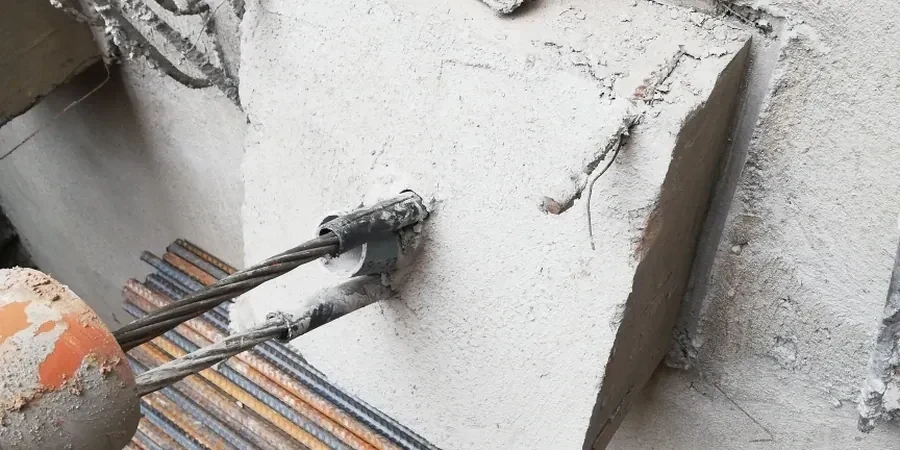
A deep basement excavation near the seafront in Southend-on-Sea started showing lateral movement at just 3.5 metres depth. The contractor had assumed a simple propped system would hold, but the London Clay was softer than expected and the water table sat higher than the borehole logs suggested. We redesigned the temporary support using multi-strand active anchors with a regroutable sleeve system, locking off at 85% of the yield load after 72 hours of creep monitoring. Southend’s geology, dominated by the London Clay Formation overlying Lambeth Group sands, demands this level of attention because the interface between stiff clay and water-bearing granular layers creates exactly the kind of conditions where passive resistance alone is unreliable. An in-situ permeability test run before finalising the anchor bond length confirmed the need for a double corrosion protection in the free length, a precaution that saved months of potential delay when the winter groundwater rose half a metre above the design assumption.
A properly designed anchor in Southend’s London Clay transfers load beyond the active failure wedge into stable ground, turning a potential excavation collapse into a controlled, predictable support system.
Quick answers
What is the difference between an active and a passive anchor?
An active anchor is prestressed after installation: we apply a controlled jacking force and lock it off against the structure, which actively compresses the ground and limits movement from day one. A passive anchor is not stressed; it only develops resistance once the ground starts to move and transfers load into the tendon. In Southend-on-Sea, we specify active anchors for most deep excavations because the London Clay creeps under sustained load, and passive systems would allow too much deflection before engaging.
How much does anchor design and testing cost in Southend-on-Sea?
For a typical project involving design, sacrificial trial anchors and on-site proof testing, the cost ranges from £740 to £2,850 depending on the number of anchors, the required corrosion protection class and the access conditions. A single temporary anchor with basic testing sits at the lower end; permanent anchors with double barrier protection and extended creep tests reach the upper end.
What ground conditions in Southend-on-Sea affect anchor performance the most?
The London Clay dominates most sites, and its behaviour depends heavily on moisture content and silt partings. When the clay is intact and firm, bond stresses are predictable. However, where it transitions into the Lambeth Group sands, water ingress can wash out the grout during installation if the borehole is not cased. The tidal Thames also influences groundwater in the Thanet Sand, causing daily fluctuations in pore pressure that affect long-term anchor capacity.
Do you carry out anchor testing on existing structures?
Yes. We perform lift-off tests on existing anchors to measure the residual load and compare it against the original lock-off value. This is common in Southend-on-Sea for retaining walls built in the 1990s and 2000s along the seafront, where corrosion or ground movement may have reduced the anchor force over time. We use a calibrated hydraulic jack and digital displacement gauge, and report results against BS 8081 acceptance criteria.