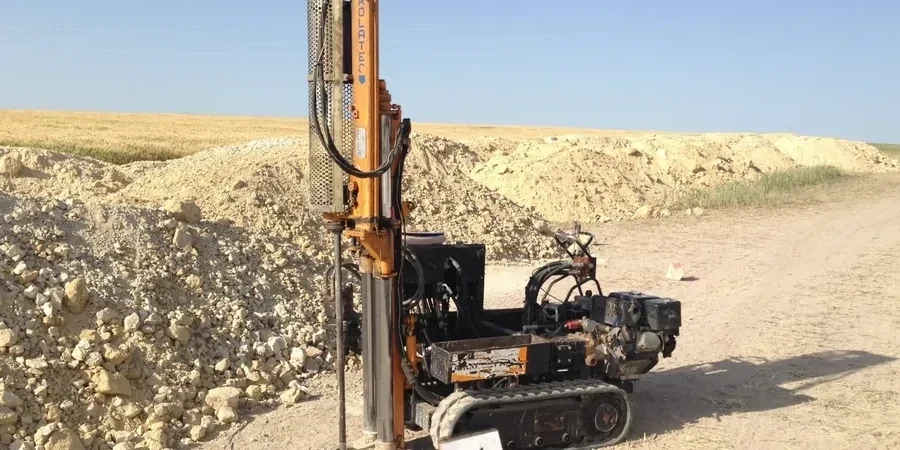
Southend-on-Sea's coastal position on the Thames Estuary exposes construction projects to a unique hydrogeological challenge: the interaction between tidal fluctuations and the underlying London Clay, overlain by layers of alluvium and sands. When groundwater movements affect excavation stability or foundation drainage, the engineering response must be grounded in data that no desktop study can carry out. We run field permeability tests directly on site, applying the Lefranc method in soils and the Lugeon test in rock, to measure hydraulic conductivity where it matters. The results feed into dewatering designs for basements near the seafront, cut-and-cover works along the A13 corridor, or soakaway assessments for developments on the Rayleigh Road expansion zone. For projects where borehole logs already exist, our in-situ permeability service builds on that stratigraphic profile with quantitative flow data, ensuring that drainage assumptions match the reality of the ground beneath Southend-on-Sea.
A single Lefranc test in a tidal alluvium layer can save weeks of dewatering over-design and prevent unexpected blow-out during excavation.
Local context
The geological succession beneath Southend-on-Sea, from recent tidal flat deposits through Pleistocene gravels into Eocene London Clay and Cretaceous chalk, creates sharp permeability contrasts over vertical distances of just a few metres. An excavation dewatered on the assumption of a uniform clay profile can encounter a sand lens connected to the estuary, leading to rapid inflow that overwhelms sump pumps and destabilises the formation. Lefranc testing at closely spaced intervals identifies these permeable seams before they become surprises. In the chalk, the risk shifts from intergranular flow to fracture-dominated flow, where a standard Lugeon test that skips pressure steps or uses a single packer can underestimate connectivity by an order of magnitude. We follow the Houlsby interpretation of Lugeon values to distinguish between laminar flow, turbulent flow, dilation, and wash-out, giving the design team a hydrogeological model they can trust when specifying grouting or cut-off walls. Skipping this level of detail in a tidal environment invites long-term problems with buoyancy, internal erosion, and sulphate attack on buried concrete.
Quick answers
How much does a field permeability test cost in Southend-on-Sea?
Field permeability testing in the Southend-on-Sea area typically ranges from £470 to £780 per test, depending on whether a Lefranc or Lugeon method is used, the depth of the test interval, and the number of pressure stages required. A full day of testing covering multiple depths in one borehole provides the best value for site characterisation, and we always quote a fixed scope after reviewing the ground investigation data.
When should I choose a Lugeon test instead of a Lefranc test?
The choice depends on the ground conditions encountered in the borehole. A Lefranc test applies to granular soils and soft cohesive deposits where water flows through the pore space; it is the standard method for assessing dewatering requirements in the sands and gravels found across Southend-on-Sea. The Lugeon test is designed for fractured rock, typically the chalk that underlies much of the area, where flow occurs through fissures rather than pores. If the borehole log shows rock with a core recovery below 90% and visible fractures, the Lugeon method will give a much more representative permeability value.
Do tidal conditions in the Thames Estuary affect permeability test results?
Yes, tidal fluctuations can influence groundwater levels in shallow aquifers near the estuary, and this needs to be accounted for when interpreting test data. We monitor water levels over at least one full tidal cycle before testing and apply barometric and tidal corrections to the analysis. The BS 5930 guidance on testing in tidal environments is part of our standard procedure for Southend-on-Sea sites, ensuring that the calculated k-value represents the formation properties rather than a transient tidal effect.