BS EN 1997-2:2007 sets the framework for ground investigation across the UK, and in Southend-on-Sea its application is shaped by the town's position on the north bank of the Thames Estuary. The geological sequence here transitions from soft Holocene alluvium and estuarine deposits into the stiff, overconsolidated London Clay beneath, and this layering demands continuous, high-resolution profiling that only the cone penetration test can deliver efficiently. A well-executed CPT campaign in Southend picks up the subtle variations in tip resistance and pore pressure that distinguish a competent gravel lens from a loose, potentially liquefiable silt, and this data feeds directly into pile design and settlement analysis. For projects spanning from the seafront to the residential expansions north of the A127, integrating CPT soundings with targeted boreholes is standard practice: the cone gives the stratigraphic detail, while the SPT drilling provides samples for index testing, building a ground model that holds up under scrutiny from building control and warranty providers alike.
In Southend's estuarine sequence, a single CPT sounding often replaces three or four boreholes for stratigraphic profiling, delivering a near-continuous log of the soil behaviour type with depth.
Local context
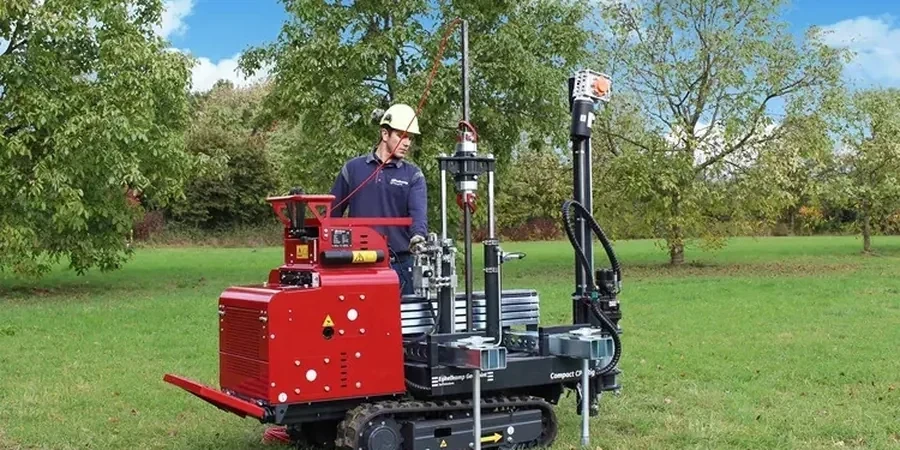
The CPT rig for Southend-on-Sea work is typically a 20-tonne tracked unit with a continuous hydraulic push system, and we fit it with a 15 cm² or 10 cm² electronic cone depending on the anticipated resistance. Pushing through the stiff London Clay requires a reaction capacity that lighter truck-mounted systems simply cannot carry out, and there are areas near the cliffs where the underlying clay comes close to the surface and refusal can occur before reaching target depth if the rig is undersized. The main operational risk in Southend is not just refusal but also damage to the cone penetrometer from flint bands within the gravels and the basal Thanet Sand, so we monitor the sleeve friction and inclination sensors in real time. An undetected bent rod or a damaged pore pressure filter renders the entire profile unreliable, and on a site where the foundation design hinges on a CPT-derived undrained shear strength profile, that kind of error translates directly into construction risk.
Quick answers
What depth can a CPT reach in Southend-on-Sea before refusal?
In the estuarine clays and silts typical of central and coastal Southend-on-Sea, a 20-tonne CPT rig normally reaches 20 to 25 metres without issue. Refusal occurs when the cone hits dense gravel layers within the River Terrace Deposits or the flint bands in the upper part of the Thanet Sand Formation. In areas where the London Clay is shallow, particularly near the cliffs to the west, refusal can happen earlier.
How much does a CPT test cost in the Southend area?
For a standard CPTu sounding in Southend-on-Sea, including mobilisation within the local area, you would typically expect a budget in the range of £140 to £220 per push depending on depth, number of dissipation tests, and site access conditions.
Can CPT testing replace boreholes for foundation design?
In many cases yes, particularly for pile and shallow foundation design in the relatively homogeneous clays and silts found across Southend-on-Sea. The CPT provides a near-continuous strength and stratigraphic profile that, when calibrated with a smaller number of boreholes for index testing, satisfies the requirements of BS EN 1997-2. It is not a complete replacement where intact samples are needed for advanced laboratory testing, but it drastically reduces the borehole count.
Do you run pore pressure dissipation tests during the CPT sounding?
We do, and in Southend-on-Sea these tests are particularly valuable. The interbedded nature of the Estuary deposits means drainage conditions change over short vertical intervals. A dissipation test measures the time for excess pore pressure to decay, allowing us to estimate the consolidation coefficient and decide whether the soil behaves drained or undrained under the proposed loading—critical for settlement predictions in the alluvial clays.
Is seismic CPT available for projects in Southend?
It is, and we recommend SCPTu for any project where the dynamic performance of the ground matters—wind turbine foundations, taller structures, or sites where the client needs a site-specific shear wave velocity profile for FE modelling. The seismic cone records the arrival time of shear waves generated at the surface, giving a direct measurement of Vs and small-strain stiffness Gmax without needing a separate geophysical survey.