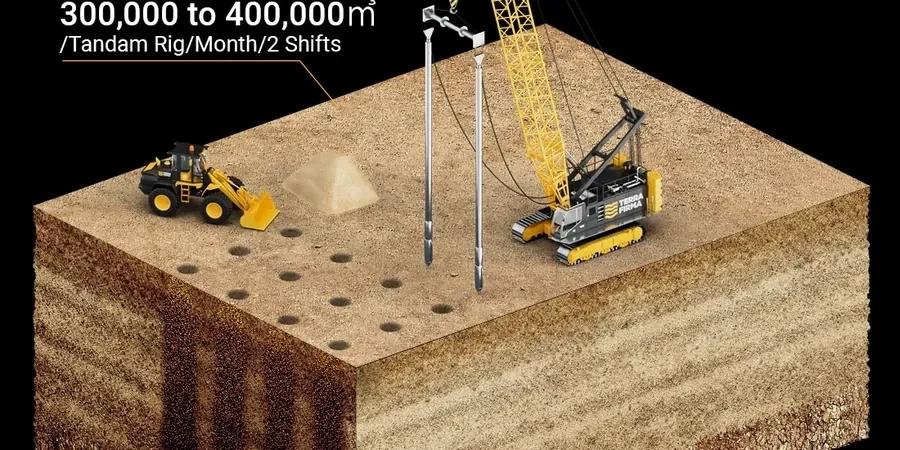
In Southend-on-Sea, the ground tells a very specific story before you even break ground on site. Much of the borough sits on layers of loose marine sand and Thames estuary alluvium, and anyone who has worked near the seafront or along the A127 corridor knows that natural density is rarely what you would hope for. Â When we review borehole logs from schemes around Victoria Avenue or the Western Esplanade, the SPT N-values often sit below 10 in the upper six to eight metresâclassic candidate ground for a well-designed vibrocompaction programme. The tidal influence and a water table barely two metres down mean the method works well here: the vibratory probe liquefies the sand skeleton temporarily, allowing particles to repack into a denser state as pore pressures dissipate. A solid design needs more than a rig and a grid, though. We tie every scheme back to CPT calibration data and, where the stratigraphy gets layered, we cross-check with spt-drilling to confirm blow-count improvement targets before committing to production parameters.
On Southendâs estuary sands, a 10â15% relative density gain from vibrocompaction can reduce post-construction settlement by halfâif the grid is tuned to the real stratigraphy, not a desktop assumption.
Local context
BS EN 1997-1:2004 requires that Improvement designs be validated against a defined performance criterion, and in Southend-on-Sea that obligation bites harder than it might inland. The combination of a high seasonal water table, tidal fluctuation, and loose silty sand means that an under-designed vibrocompaction scheme can leave a site with residual liquefaction susceptibilityâsomething that matters acutely in a seismically quiet but hydraulically active coastal setting. Even without earthquake loading, the cyclic stress from rising and falling groundwater can trigger localised settlement in poorly compacted zones. Our risk assessment quantifies three things before the first probe goes in: the expected settlement under service load, the post-treatment improvement factor for bearing capacity, and the residual risk of fines migration clogging the drainage path. Where the cone resistance profile shows interbedded clays, we specify closer probe spacing or supplementary vertical drains to manage pore pressure dissipation. The design report includes a commissioning test section with pass-fail criteria tied to CPT tip resistance and sleeve friction, not just a target depth log, so the contractor and the building control officer both have a transparent acceptance benchmark.
Quick answers
What ground conditions in Southend-on-Sea respond best to vibrocompaction?
Clean to slightly silty sands with fines content below about 15% give the most reliable densification. Much of the boroughâs estuary margin fits that description, though we always check for thin clay seams or peat pockets that can block pore pressure dissipation. A pre-design CPT profile tells us within a day whether vibrocompaction alone will work or whether a hybrid approach is needed.
How is the design grid spacing determined?
We start with empirical charts based on SPT or CPT data and target relative density, then run a test sectionâtypically 10 to 20 probe pointsâon the actual site. Post-test CPTs are compared with pre-test baselines, and the spacing is tightened where the improvement ratio falls short. Grids in Southend-on-Sea commonly end up between 2.2 and 3.0 metres triangular, but the number is always site-specific.
What does vibrocompaction design and execution cost for a typical Southend-on-Sea site?
For a reasonably accessible site requiring treatment over 200â500 m², design plus trial section and production monitoring typically falls between £1,060 and £3,600, depending on depth, grid density, and verification requirements. A fixed quotation is provided after reviewing the ground investigation data and site access constraints.
How do you verify that compaction has achieved the design target?
We specify pre- and post-treatment CPT soundings at agreed locations, comparing cone resistance and friction ratio directly. For larger schemes we add zone load tests or SPT checks at selected depths. All results are plotted against the acceptance envelope defined in the design report, so there is a clear pass-fail record for the warranty file.