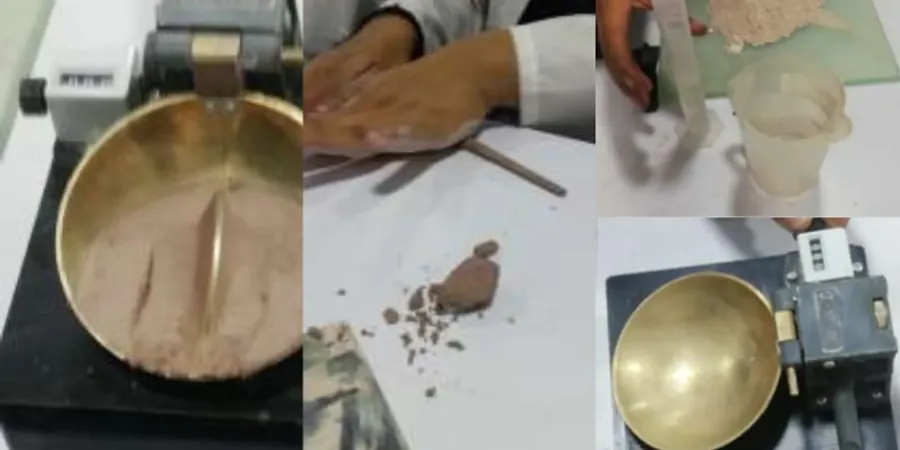
When working on the north bank of the Thames Estuary, BS 5930 and BS EN 1997-2 leave no room for guesswork: you need the Atterberg limits before you commit to a foundation type. Southend-on-Sea sits on a layered sequence of London Clay, silty brickearth, and pockets of alluvial soft clay that change behaviour dramatically with water content. In our expertise, a seemingly stiff clay can turn plastic within half a metre of depth, and that shift has direct consequences for bearing capacity calculations. The liquid limit and plastic limit test — run in our ISO 17025-accredited laboratory — gives you the plasticity index and liquidity index you need to classify the material correctly. For deeper investigation, we often pair the limits with a grain-size analysis to confirm the silt-clay fraction, and on sites near the seafront where sands appear, an SPT drilling campaign captures the density profile that the Atterberg data alone cannot reveal.
In Southend-on-Sea, the plasticity index of the London Clay can reach 45%, placing it in the high-plasticity range that demands careful foundation detailing under Eurocode 7.
Local context
The estuary climate adds a layer of risk that inland sites simply do not face. Southend-on-Sea gets around 550 mm of rainfall annually, but the real problem is the high groundwater table perched in the gravel lenses that underlie the clay across much of the borough. When the water table rises in late autumn, clay that tested as stiff in September can behave as firm or even soft by December. If the Atterberg limits were determined on dry-season samples without accounting for seasonal saturation, the liquidity index will be misleadingly low, and the designer ends up with an overestimated undrained shear strength. The consequence we have seen on several local projects is excessive settlement or, in the worst case, a bearing failure at the base of a shallow footing. BS EN 1997-1:2004 requires that the design profile reflects the most unfavourable groundwater condition, and the Atterberg limits — combined with a realistic moisture content — carry out the quickest check on whether the soil will hold its strength when wet. For sites within 500 metres of the tidal foreshore, we always recommend repeating the limits test on samples taken at the end of the wet season to capture the true design envelope.