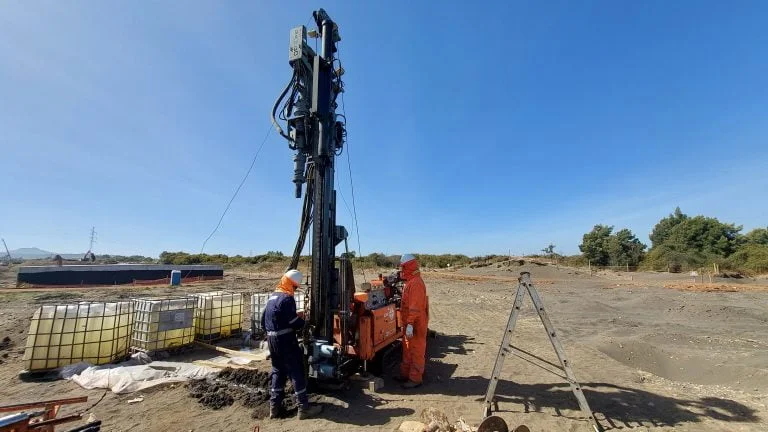
A common misstep in Southend-on-Sea is assuming uniform ground conditions beneath a site simply because neighboring properties show no distress. The reality across the borough, from the London Clay outcrops inland to the complex sequences of alluvium and brickearth nearer the Thames Estuary, is far more variable. Relying solely on borehole data can miss shallow lenses of soft peat or pockets of made ground that an exploratory test pit would expose directly. Our team uses the exploratory test pit method to carry out a clear window into these first few meters of strata, allowing for a visual and tactile assessment that no downhole tool can replicate. When combined with laboratory testing, this approach delivers the factual data required for a solid geotechnical design under BS 5930:2015 and Eurocode 7.
A single test pit can reveal more about shallow ground variability than a dozen machine-driven boreholes in the estuarine clays of Southend-on-Sea.
Process overview
A practical observation from years of work along the Essex coastline is that the depth of the water table in Southend-on-Sea fluctuates significantly between the chalk aquifer and the overlying superficial deposits, often appearing within the first two meters. An exploratory test pit allows the logging team to observe seepage patterns and groundwater ingress directly, which is critical when planning dewatering or basement construction. The method also permits the extraction of high-quality, undisturbed block samples from cohesive layers, which are far more representative for strength testing than disturbed bag samples.
We log each pit face according to BS 5930, recording lithology, consistency, discontinuities, and the presence of any obstructions. For projects requiring a broader stratigraphic context, data from the exploratory test pit can be integrated with
CPT testing to correlate discrete soil behaviour with continuous profiling, ensuring that the ground model accurately reflects conditions across the entire footprint of the proposed structure.
Local context
The coastal climate of Southend-on-Sea introduces a specific risk: a rapid rise in pore water pressure during tidal cycles can soften the base of an open test pit within hours, even in stiff London Clay. This demands that logging and sampling be completed efficiently, often with temporary sump pumping, before the sidewalls begin to degrade. A collapse not only endangers personnel but also invalidates the exposure before a complete record can be made. The presence of historic landfill and reworked ground across the town’s Victorian and mid-century expansion zones adds further uncertainty, as old cellars or buried concrete rafts can limit excavation depth. A thorough service search and a CAT scan prior to breaking ground are non-negotiable steps that we embed in every site-specific risk assessment and method statement, ensuring compliance with CDM 2015 regulations and our ISO 9001 certified quality management system.
Quick answers
What are the typical costs for an exploratory test pit in Southend-on-Sea?
For a standard test pit up to 3.5 metres deep with a factual report, the cost typically ranges between £380 and £700, depending on access restrictions, the number of pits required, and the volume of laboratory testing specified.
How long does it take to excavate and log a single test pit?
A single pit can usually be excavated, logged, sampled, and backfilled within one working day, provided the ground is stable and no unexpected obstructions are encountered. The factual report with logs and photographs is typically issued within five working days.
Is an exploratory test pit better than a borehole for shallow ground?
For the uppermost four metres, a test pit offers superior visual information. It exposes a continuous face where you can see fissures, shear surfaces, and the contact between different strata, whereas a borehole only provides a discontinuous core that can be disturbed during drilling.
What happens if you hit the water table during excavation?
If groundwater is encountered, we measure the rate of ingress and record the standing water level after a short stabilisation period. A sump is dug at one corner of the pit to collect water, which is then pumped out if necessary to keep the working face dry enough for logging.
Do you need council or building control approval to dig a test pit?
Test pits for ground investigation are generally permitted development, but we always recommend informing the local building control team at Southend-on-Sea Borough Council. If the site is in a conservation area or near protected trees, specific permissions may be required before breaking ground.