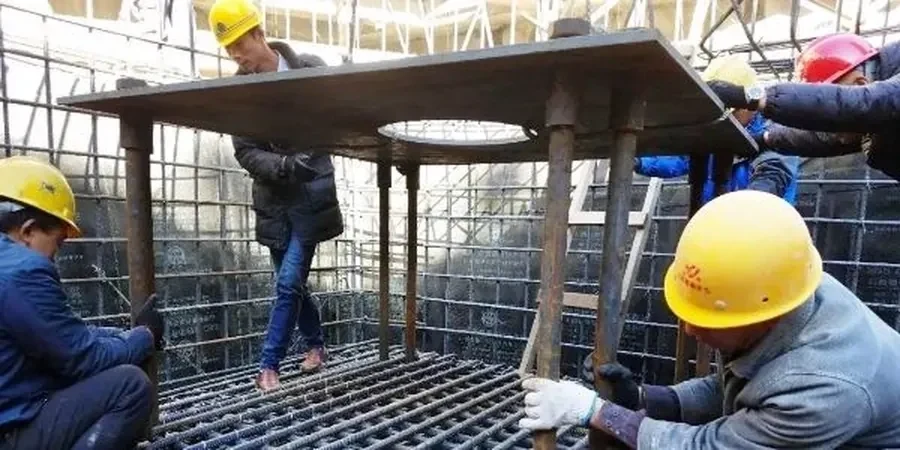
A three-storey residential block near the cliffs in Southend-on-Sea recently presented a problem. The developer wanted open-plan ground-floor parking, but conventional reinforced concrete frames on the local London Clay would have required massive shear walls. That changes the architectural intent and the budget fast. We came in to look at a base isolation scheme. Southend-on-Sea sits on a mix of alluvium, terrace gravels, and London Clay, and while UK seismicity is moderate, the site amplification on soft soils can be significant. The solution was a set of elastomeric isolators placed above the foundation level, decoupling the superstructure from ground motion. Before committing to the design, the team ran a MASW survey along the footprint to map Vs30 and confirm the site class, and correlated the results with seismic refraction profiles to verify bedrock depth.
Base isolation on Southend's soft soils can reduce floor accelerations by up to 60% compared to fixed-base designs.
Process overview
On the Essex coast we repeatedly see the same condition: stiff clay over softer alluvial layers, with a water table barely two metres down. That stratigraphy means ground motion doesn't travel uniformly. Short-period energy can amplify in the upper clays, while longer-period waves interact with the deeper basin geometry. A base isolation system here must handle both spectral demands. We typically model the isolator hysteresis using nonlinear time-history analysis, calibrating the lead-rubber bearing properties to the 475-year return period spectrum from Eurocode 8. The isolators shift the building's fundamental period well beyond the dominant site period, reducing floor accelerations by up to 60% compared to a fixed-base design. For structures in Southend-on-Sea with irregular mass distribution or soft-storey layouts, this approach often eliminates the need for ductile detailing that would otherwise drive construction costs up.
In practice, the design sequence matters. After site-specific ground investigation we define the design displacement and effective damping for each isolator unit. The moat wall detail, which allows the building to move freely during an event, must account for the total maximum displacement plus an allowance for torsional rotation. We coordinate this with the structural engineer early, because the isolation plane affects every service penetration, staircase, and lift pit. For projects where soil stiffness is borderline, combining base isolation with
deep soil mixing or grouting beneath the foundation mat improves bearing capacity and reduces differential settlement before the isolators are even installed.
Local context
The Thames Estuary coastline introduces a risk that isn't obvious on a drawing board: long-term settlement of alluvial clays under cyclic loading. Southend-on-Sea's geology includes pockets of soft silty clay that can lose stiffness during prolonged shaking, a phenomenon related to cyclic degradation rather than classic liquefaction. A base isolation system reduces the seismic demand transmitted to the foundation, but the isolators themselves must survive the full design displacement without buckling or cavitation. The moat detail becomes critical here. If the perimeter retaining wall is too close, or if service ducts aren't detailed with flexible couplings, even a well-designed isolation plane will lock up when the building needs to move. We've seen retrofit projects where a poorly executed moat cover nullified half the isolation benefit. Our design process includes a peer review of the moat clearance, isolator stability at maximum displacement, and the connection detailing for gas, water, and electrical risers crossing the isolation plane.
Quick answers
Is base isolation necessary for buildings in Southend-on-Sea given the UK's low seismicity?
The UK's seismic hazard is indeed moderate, but the combination of soft alluvial soils along the Thames Estuary and the site amplification effect can produce ground motions that are damaging to rigid mid-rise structures. Base isolation becomes a cost-effective strategy when a building's occupancy class (III or IV per Eurocode 8) demands enhanced seismic performance, or when architectural constraints prevent the use of large shear walls.
How long does the design process take for a base isolation project?
A typical feasibility and concept design phase takes four to six weeks, assuming ground investigation data is already available. Detailed design, including nonlinear time-history analysis and coordination with the structural and MEP teams, usually runs for an additional eight to ten weeks. The timeline depends heavily on the complexity of the soil-structure interaction and the number of isolator types being evaluated.
What is the typical cost range for base isolation design in Southend-on-Sea?
Design fees for a base isolation scheme on a mid-rise building in Southend-on-Sea typically fall between £2,830 and £6,580, depending on the scope of analysis, the number of ground motion records processed, and the level of construction-phase support required. Isolator hardware and installation are separate costs managed by the contractor.