← Home · Improvement

Grouting Design for Variable Ground in Southend-on-Sea

Together, we solve the challenges of tomorrow.

SEE MORE →

Southend-on-Sea's expansion from a modest fishing village into a major Thames Estuary town left a legacy of complex ground conditions beneath its Victorian terraces and seafront structures. The geological transition from the stiff London Clay formation to the underlying Thanet Sand, often capped by unpredictable made ground, demands a grouting design approach that goes beyond standard prescriptions. Our team deals daily with the challenges of stabilising ground where old creeks were infilled and where the water table sits barely two metres below the surface. A solid grouting scheme here must account for tidal fluctuations that can reach over 6 metres at Southend Pier—the longest pleasure pier in the world—and the aggressive sulphate environment that attacks cementitious binders if not properly formulated.

Grout take in Southend's Thanet Sand can vary 40% between boreholes less than 5 metres apart—design must assume heterogeneity, not uniformity.

Process overview

A common mistake on Southend-on-Sea sites is treating all loose granular deposits with a single cement-based grout mix, ignoring the fines content that chokes permeation paths in Thanet Sand lenses. We see this on extensions to schools and residential blocks near the seafront, where low-viscosity microfine cements or colloidal silica would achieve better penetration radii without hydrofracturing the formation. The design must specify target permeability reduction (commonly k ≤ 1×10⁻⁶ m/s for cut-off curtains beneath basements) and confirm rheology with Marsh funnel tests before any bulk batching. For sites with sensitive adjacent structures—Victorian brick sewers are a particular concern in the conservation area around Clifftown—real-time pressure monitoring and a pre-defined refusal criteria are non-negotiable. When the ground profile includes organic silts, a liquefaction assessment feeds directly into the grouting parameters, particularly where cyclic loading from estuary traffic or future seismic events is a design consideration.
Grouting Design for Variable Ground in Southend-on-Sea
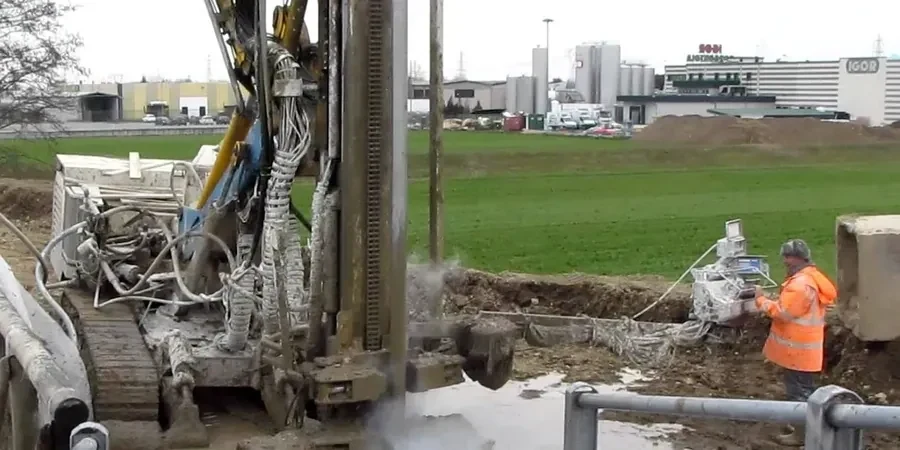
Technical reference image — Southend-on-Sea

Local context

A nine-storey residential project on the site of a former amusement arcade near Marine Parade encountered 3.2 metres of uncompacted ash and rubble directly over a confined aquifer in the Thanet Sand. The initial grouting design underestimated the lateral continuity of the made ground voids, and during the first phase of drilling, grout daylighted through a disused drainage culvert 18 metres from the injection point. We redesigned the scheme with a double-row curtain, reducing the primary spacing to 1.5 metres and switching to a thixotropic grout with a gel time under 90 seconds. Supplementary tube-à-manchette installation allowed re-injection where takes exceeded 300 litres per linear metre. The lesson: in Southend-on-Sea's coastal strip, historical mapping of buried services and former structures is as critical to the grouting design as the SI data itself. Uncontrolled grout loss into unknown voids can escalate costs by 50% in a single week.

Need a geotechnical assessment?

Reply within 24h.

Email: contact@geotechnical-engineering1.com

Technical parameters


ParameterTypical value
Design standardBS EN 1997-1:2004 (Eurocode 7) + UK National Annex
Ground investigation codeBS 5930:2015+A1:2020
Target permeability (cut-off)k ≤ 1×10⁻⁶ m/s
Grout type for Thanet SandMicrofine cement / colloidal silica
Typical injection pressure limit50–200 kPa (surcharge-dependent)
Borehole spacing for treatment1.2–2.5 m staggered grid
Marsh funnel viscosity range32–42 seconds (dependent on mix design)
Sulphate resistance classSR/SSR cement per BRE Special Digest 1

Additional services

01

Permeation Grouting Design

Low-pressure injection schemes for Thanet Sand and granular made ground, specifying grout rheology, stage lengths, and refusal criteria to achieve permeability cut-offs beneath basements and infrastructure in Southend-on-Sea's high-water-table environment.

02

Compaction and Compensation Grouting

Fracture-mode grouting design for lifting settled structures on soft alluvium or for pre-treatment beneath raft foundations. Includes real-time heave monitoring protocols and stage injection sequencing referenced to BS EN 12715.

Reference standards

BS EN 1997-1:2004 Geotechnical design – General rules, BS 5930:2015+A1:2020 Code of practice for ground investigations, BS EN 12715:2020 Execution of special geotechnical work – Grouting, BRE Special Digest 1 – Concrete in aggressive ground

Common questions

What ground investigation data is essential before grouting design in Southend-on-Sea?

At minimum, you need borehole logs to BS 5930 identifying the full sequence of made ground, any soft alluvial clays, and the top of the Thanet Sand. Particle size distribution curves (BS 1377-2) are essential to assess groutability by the Mitchell criterion. We also require in-situ permeability tests at the target depth—falling-head tests in standpipes or packer tests in the Thanet Sand—to calibrate the injection rate. For sites within 500 metres of the estuary, groundwater chemistry analysis for sulphates and chlorides determines cement type and durability specification.

How much does a grouting design package cost for a residential project in Southend-on-Sea?

For a typical residential development in Southend-on-Sea—say a block of 6–12 flats with a single-level basement—a complete grouting design package including ground investigation interpretation, mix design specification, injection parameter schedule, and construction-phase support falls between £1,020 and £2,960 depending on the complexity of the ground profile and the number of treatment zones.

What verification testing do you specify for grouting works?

Our designs include a verification plan with three stages: during grouting, we monitor pressure, volume, and flow rate against predicted envelopes; post-grouting, we specify Lugeon or falling-head tests in verification boreholes at a density of one per 50 m² of treated area; and for critical cut-offs beneath retaining structures, we may require cross-hole seismic tomography to confirm homogeneous treatment. All testing is referenced to the acceptance criteria defined in BS EN 12715.
Location and service area

We serve projects across Southend-on-Sea and its metropolitan area. More info.

View larger map