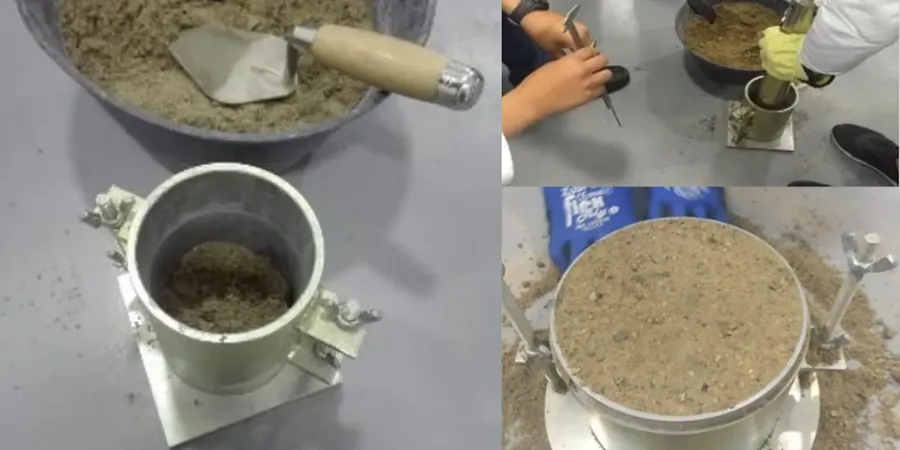
The most common call we get from Southend-on-Sea contractors starts the same way: the roller has made twenty passes but the fill still feels spongy underfoot. In nearly every case the material was placed without a proper moisture-density relationship established first. London Clay and the overlying brickearth around the Thames Estuary can look dry on the surface yet hold 22% moisture a few centimetres down, and once that wet clay is compacted without knowing its optimum water content the result is a mass that traps pore pressure instead of shedding it. Running a Proctor test on the borrow material before it reaches the site saves days of reworking later. We perform both Standard Proctor (2.5 kg hammer, 305 mm drop) and Modified Proctor (4.5 kg hammer, 457 mm drop) in our UKAS-accredited soils laboratory, and the report includes the full compaction curve so the site team has a target density range, not just a single number.
A Proctor curve isn't just a lab report — it's the compaction target that decides whether three passes of a roller are enough or whether the fill needs to be scarified and re-laid.
Process overview
BS 1377-4:1990 governs our Proctor procedures, and for Southend-on-Sea jobs we always check whether the specification references BS 6031:2009 for earthworks on the London Clay Formation. The Modified Proctor effort (about 2,700 kN-m/m³) is typically specified for heavy-duty pavement subgrade and structural fill beneath foundations, while the Standard Proctor (roughly 600 kN-m/m³) still appears in landscaping and low-rise residential schemes. A critical local consideration is the variable sand content in the brickearth deposits stretching from Shoeburyness toward Leigh-on-Sea; even a 5% shift in fines content changes the compaction curve significantly. We therefore run the test on three separate sub-samples from the same bulk bag, using the 2.5 kg rammer with 27 blows per layer across three layers for the Standard method, or five layers at 27 blows for Modified. The oven-drying stage follows BS 1377-2:1990 at 105°C ± 5°C, and we cross-check the moisture content with a rapid microwave method when turnaround time is tight. For sites near the seafront where fill may contain traces of salt, we also assess whether the standard moisture-correction formula remains valid or whether a site-specific calibration is warranted — something we have learned after testing over 400 samples from the Southend coastal belt.
Local context
Southend-on-Sea sits on a wedge of Eocene London Clay overlain by Pleistocene brickearth and Holocene alluvium, with groundwater often within 1.5 metres of ground level in the lower-lying wards near the estuary. When Proctor data are missing or assumed from a generic database, the consequences stack up quickly: under-compacted clay swells during wet winters, causing differential heave beneath floor slabs in developments around Thorpe Bay, while over-compacted sandy fill placed too dry can collapse on first saturation. We have seen cut-and-fill sites near the airport where the earthworks spec called for 95% relative compaction, yet the reference Proctor value was taken from a quarry 40 miles away in Kent — the soil was not the same, and the contractor spent three weeks re-rolling lifts that had already passed an inappropriate target. A project-specific Proctor test on the actual borrow material costs a fraction of that rework and gives the site team an achievable density range matched to the local geology. For deep fills exceeding 2 m, we recommend running both Standard and Modified curves during the pre-construction phase so the designer can select the appropriate compactive effort for each lift thickness.
Quick answers
What does a Proctor test cost in Southend-on-Sea?
A Standard Proctor test on a single sample typically runs between £90 and £130; a Modified Proctor is £130 to £190. The final figure depends on whether you need one or both compactive efforts, how many sub-samples are required, and whether rapid microwave moisture determination is used. We quote per project once we know the borrow source and the earthworks specification.
How long does a Proctor test take?
Standard turnaround is 48 hours from sample receipt. We can deliver same-day results using the microwave drying method when the sample arrives before 10:00 am — this option is popular with Southend contractors who need to start compacting the following morning.
Which Proctor method applies to my Southend project?
It depends on the specification. Modified Proctor is the default for structural fill under foundations and road subgrade (Highways England Series 600 requires Modified effort). Standard Proctor still appears in domestic landscaping and some utility trench reinstatement specs. If the contract is ambiguous, we recommend running both curves during the pre-construction phase so the designer can make an informed choice based on the actual soil characteristics.
What soil types can you test?
Our equipment handles clay, silt, sand, gravel, and mixtures with up to 20% retained on the 20 mm sieve — which covers the full range of London Clay, brickearth, and Thames gravels found across the Southend-on-Sea area. For material with a larger coarse fraction we switch to the CBR mould per BS 1377-4 and apply the replacement procedure for oversized particles.